Your competitors have already spent money finding out what works on YouTube.
Which hooks keep people watching. Which offers get clicks. Which videos they run for months because they keep making sales.
Why not learn from that? In this guide I'll show you how to spy on your competitors' YouTube ads, what to look for and, most importantly, how to turn what you find into better campaigns of your own. If you just want a side-by-side comparison of software, check out our list of the 10 best YouTube ad spy tools in 2026.
Let's start with why this matters.
Why Spy on Competitor YouTube Ads?

YouTube has more than 2 billion active users. In 2023 alone, over $31.51 billion was spent on YouTube ads.
That's a lot of competition for attention.
Guessing is expensive. Every ad you test blind costs money before you learn anything. Studying competitor ads gives you a head start. You see the angles, formats and offers that are already working in your niche, before you spend a cent.
Here's what good ad research can tell you.
- Ideas for your ad copy, hooks and video style
- Which products or offers are in demand right now
- How your rivals position themselves and what they promise
- How long and how often they run their ads
- Gaps in the market nobody is talking about yet
Step 1. Decide What You Want to Learn
Don't start by browsing aimlessly. You'll watch fifty ads and remember none of them.
Pick one clear goal first. Are you trying to improve your ad creative? Find a better offer? Figure out who to target? Each goal changes what you pay attention to.
Write it down. It sounds obvious. It works.
Step 2. Make a List of Competitors
Start with five to ten names.
Include the obvious direct competitors, but also brands that sell to the same audience with a different product. If you sell a fitness app, a supplement brand chasing the same viewers is worth watching too.
Not sure who's advertising? Search your main keywords on YouTube and watch a few videos in your niche. Note which brands keep showing up before and during those videos.
Step 3. Find Their Ads
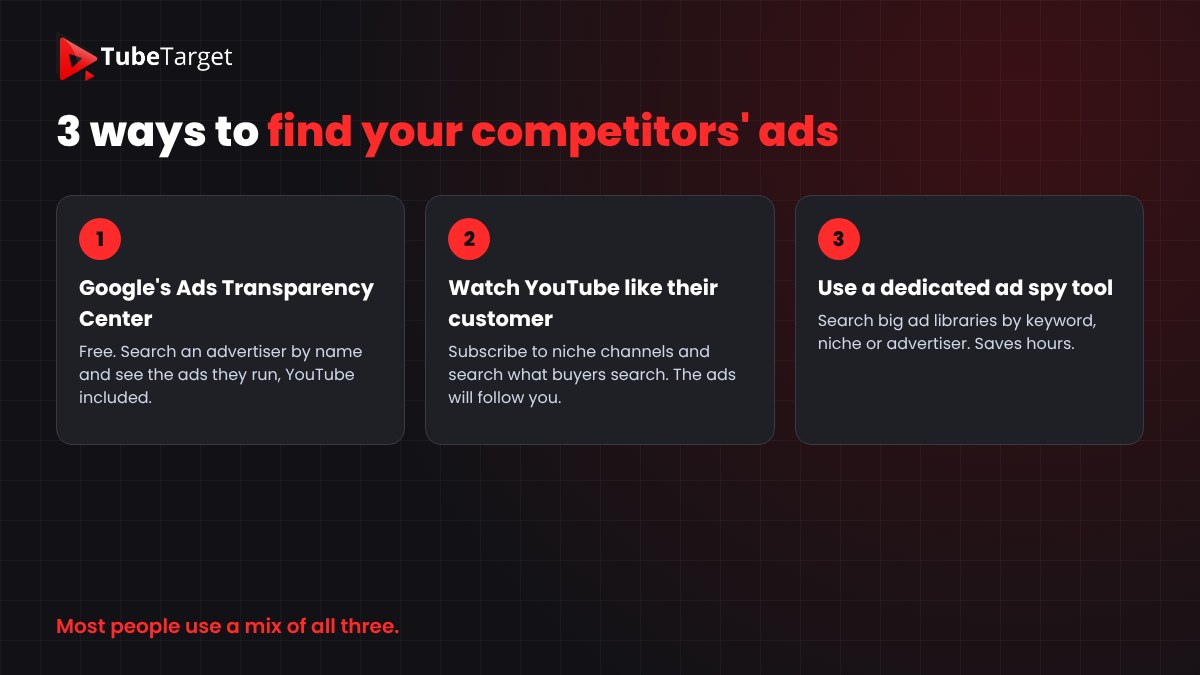
There are three main ways to find competitor ads. Most people use a mix.
Use Google's Ads Transparency Center
It's free. Search for an advertiser by name and you can see the ads they're running across Google's platforms, including YouTube. A great place to start before you pay for anything.
Watch YouTube Like Their Customer
Watch the kind of videos your competitors' buyers watch. Subscribe to a few channels in your niche. Search the terms your customers search. Ads will start following you.
It's slow, but you see the ads exactly the way real viewers do.
Use a Dedicated Ad Spy Tool
Paid tools collect large libraries of ads you can search by keyword, niche or advertiser. Some focus on YouTube, like VidTao. Others like AdSpy, PowerAdSpy, Adbeat and AdPlexity cover several platforms. They save hours if you do this research regularly.
Step 4. Break Down Every Ad
Finding ads is the easy part. Learning from them is where the value is.
Make a simple swipe file. A spreadsheet works fine. For every ad you save, note these things.
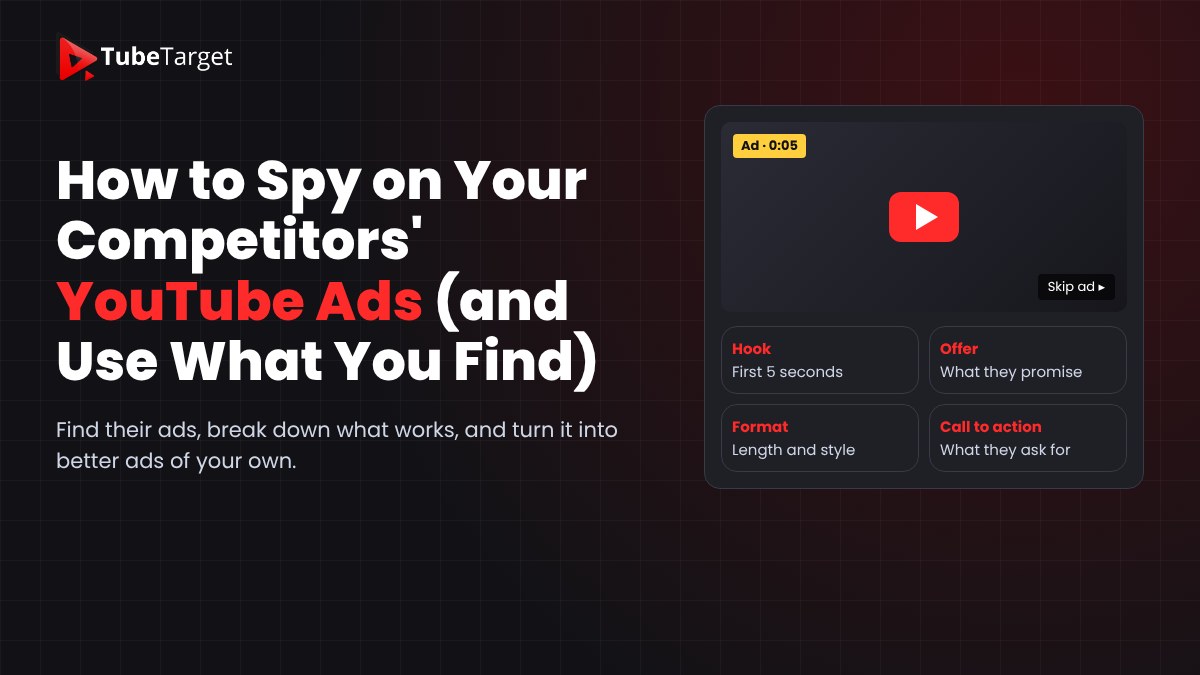
- The hook. What happens in the first few seconds before a viewer can skip?
- The offer. Free trial, discount, lead magnet, straight sale?
- The format. Talking head, screen recording, testimonial, animation?
- The length. Short and punchy or a long story?
- The call to action. What exactly do they ask the viewer to do?
- The landing page. Click through and see where it leads. What's the headline? What's the price?
Then look for one more thing. How long has the ad been running?
Nobody keeps paying for an ad that loses money. An ad that has been live for months is probably making a profit. Those are the ones to study hardest.
Step 5. Spot the Patterns
One ad tells you very little. Twenty ads tell you a story.
After a week or two of collecting, go through your swipe file and look for repeats. Do most competitors open with a question? Do they all push a free trial? Is everyone using customer testimonials?
Patterns show you what the market responds to.
And the gaps show you where to stand out. If every ad in your niche looks the same, a different angle might be exactly what gets noticed.
Step 6. Turn Insights Into Your Own Ads
Here's the rule. Use competitor ads for inspiration, never imitation.
Copying someone's script word for word is lazy, risky and bad for your brand. Instead, take the principle. If long-running ads in your niche all open by naming a specific pain, write your own hook that names that pain in your own voice. If they all lead with a free trial, test whether a trial beats your current offer.
Make two or three versions of your ad based on what you learned. Then let the data decide.
Step 7. Put Your Ads Where Their Buyers Are Watching

This is the step most people skip. And it's the one that makes money.
Spying shows you what to say. It doesn't tell you where to say it.
On YouTube you can place your ads on specific channels and videos. The channels your competitors' customers watch are a ready-made targeting list. But there's a catch. You can only place ads on monetized channels and videos, and finding the right ones by hand takes forever.
That's what TubeTarget is for. It doesn't show you competitors' ads. It finds the monetized YouTube channels and videos in your niche so you can run your ads right where interested buyers are already watching.
No content creation. No video SEO. Just targeted placements for your campaign. It costs $6.99 a month or $67 a year.
So the full workflow looks like this. Research what your competitors say, write a better ad, then use TubeTarget to place it in front of the same audience.
Step 8. Measure and Keep Watching
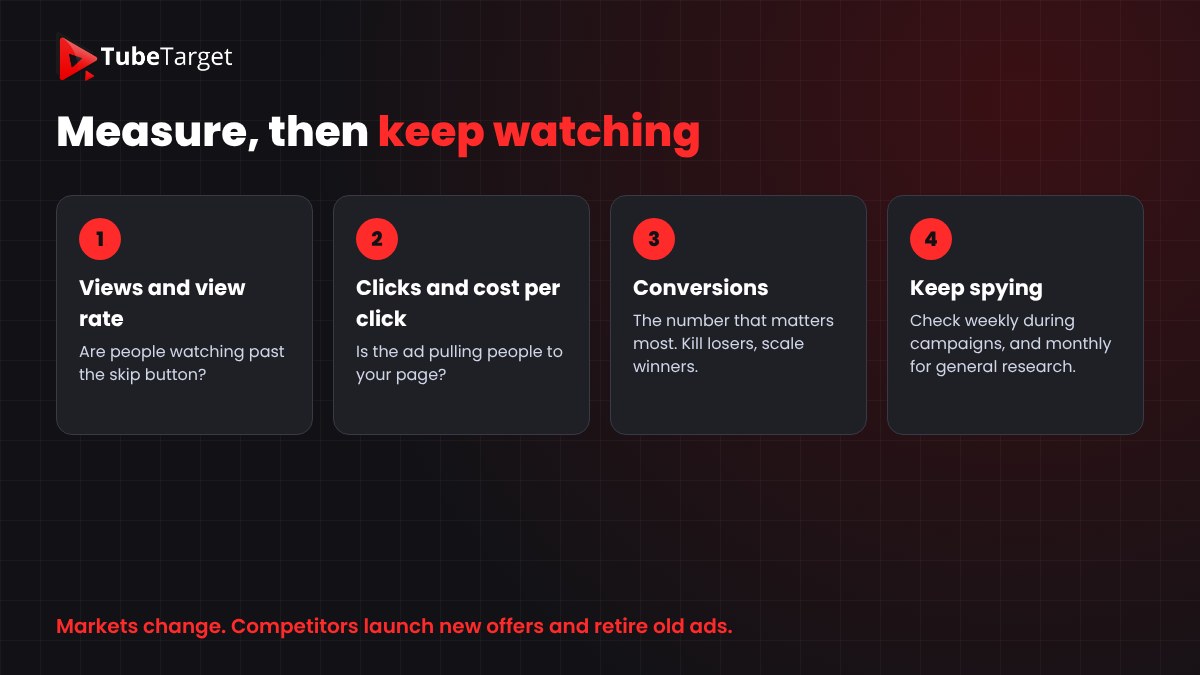
Once your ads are live, track the numbers that matter. Views, view rate, clicks, cost per click and, above all, conversions.
Kill what doesn't work. Scale what does.
And keep spying. Markets change. Competitors launch new offers and retire old ads. Check in weekly while you're running active campaigns, and at least monthly for general research.
Final Thoughts
Spying on competitor YouTube ads isn't about copying. It's about skipping the expensive guesswork.
Set a goal. Find their ads. Break them down. Spot the patterns. Write something better. Then put it where their buyers are watching.
Want to compare research tools before you start? Here's our roundup of the 10 best YouTube ad spy tools in 2026.
FAQs About Spying on YouTube Ads
Is it legal to spy on competitor YouTube ads?
Yes. You're looking at ads that are publicly shown to viewers. Just use what you learn responsibly and don't copy anyone's work directly.
How often should I check competitor ads?
Weekly for active campaigns, and at least once a month for general market research.
Will this guarantee my ads succeed?
No. Research gives you a better starting point, but success depends on how well you adapt those ideas to your own brand and audience.
Do I need technical skills?
Not really. Most spy tools are built to be easy to use, and the free Transparency Center needs nothing more than a browser.